By Bill Hartzer · Published · Updated · How this site is researched
What happened
On October 7, 2025, Brooke Schinault reported to St. Petersburg police that a man had broken into her home and sexually assaulted her. She supplied an image of the man she said was responsible. The report drew a response from multiple officers, rescue personnel, a detective and a forensic technician, according to The Smoking Gun.
A detective reviewing the case recognized the image as part of a viral online trend in which users generate pictures of a supposed stranger in their home. Investigators found the image in a deleted folder on Ms. Schinault's device, created days before the reported crime. Police stated, as reported by AOL, that "It was later found the photo was AI generated via ChatGPT." A police spokesperson, Ashley Limardo, told Bay News 9 that such an image "can be very dangerous. Especially if this person had matched someone's description in our town."
What the court did
Ms. Schinault was charged with 2 counts of false report of a crime, and bond was set at $1,000, according to Bay News 9. On December 1, 2025, she pleaded no contest to misdemeanor false reporting. The Smoking Gun and AOL reported that she was placed on probation and ordered to pay a fine.
Where it stands
The case is closed. This record did not locate the court file, and the account rests on news reporting. One report gives October 2024 as the date of the false report. Bay News 9 and the AI Incident Database give October 7, 2025, which this entry follows.
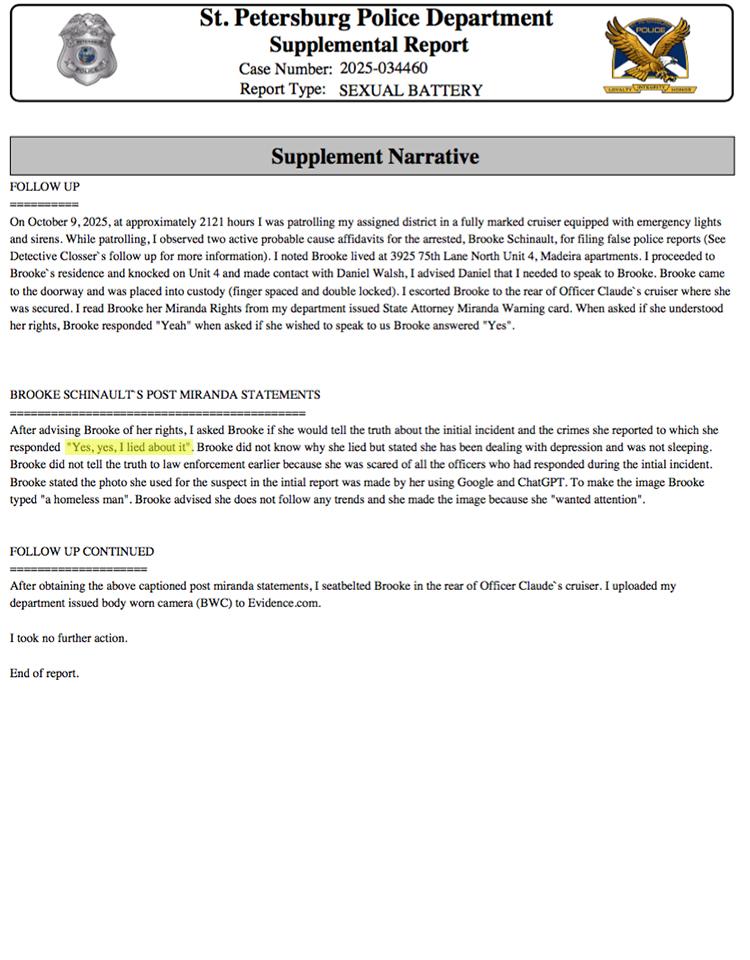
Update, October 2026. The St. Petersburg Police Department supplemental report, Case No. 2025-034460, has been read as posted by The Smoking Gun. The officer's narrative records that Ms. Schinault said "the photo she used for the suspect in the intial report was made by her using Google and ChatGPT," and a detective's supplement of October 9, 2025 ties the image to an online AI trend. The plea and judgment records were still not located.
The obligation it engaged
The person involved was a complainant, not a professional, so the Standard applies to those who received the image. A generated picture was offered to investigators as a depiction of a real suspect. Had it been circulated as a wanted image, it could have pointed attention at any real person who resembled it. Independent authority asks that a depiction be confirmed against its source before it is relied on. Here the image's origin was traced by recognizing the trend and by the device's own file history.
For digital examiners the matter is a reminder that provenance can often be settled by ordinary means. File location, creation date and deletion history on the source device answered the question. No AI detector was needed, which is the governing test applied to a single photograph.
Sources
- Bay News 9 · November 3, 2025
St. Pete woman accused of using AI to create fake suspect - The Smoking Gun · December 2, 2025
Woman Guilty Of ChatGPT Rape Hoax - AOL · December 6, 2025
Woman admits to using AI to create fake rape story, mirroring TikTok challenge - St. Petersburg Police Department (supplemental report, posted by The Smoking Gun) · October 9, 2025
Supplemental report, Case No. 2025-034460
What could not be confirmed
The court, judge, probation length and fine amount were not confirmed. Sources disagree on the year of the report (2024 in one account, 2025 in others).
About this entry
This entry was checked against the primary document listed in the sources. The entry for Florida v. Schinault records conduct and what the tribunal did. It does not characterize a holding and it is not legal advice. Last checked October 8, 2026. More matters like this one are collected under deepfake and AI-enhanced evidence. If something here is out of date, write to [email protected].