By Bill Hartzer · Published · Updated · How this site is researched
When the evidence itself is synthetic
This part of the record follows matters in which the evidence itself was produced or changed by an AI system, or in which a party said it had been. It is distinct from matters about lawyers or experts using AI to write briefs and reports. Here the question is usually whether a recording, image or video is what its proponent says it is. A newer question is whether a person's own exchanges with an AI system can be seized and used as evidence.
The entries fall into 5 groups. Some involve a deepfake (synthetic audio, video or images made to look like a real person or event) offered to a court, the police or the public as genuine. Some involve AI-enhanced media, where a real recording was processed by a system that adds or predicts detail, or where generated media was shown in court openly. Some involve the deepfake defense, in which a party resists genuine evidence by suggesting it could have been faked. The last group concerns how courts decide authentication (the threshold showing that an item is what it is claimed to be) when fabrication is easy. A fifth group concerns records of a person's own conversations with an AI system, and whether privilege protects them.
Fabricated media and the claim of fabrication
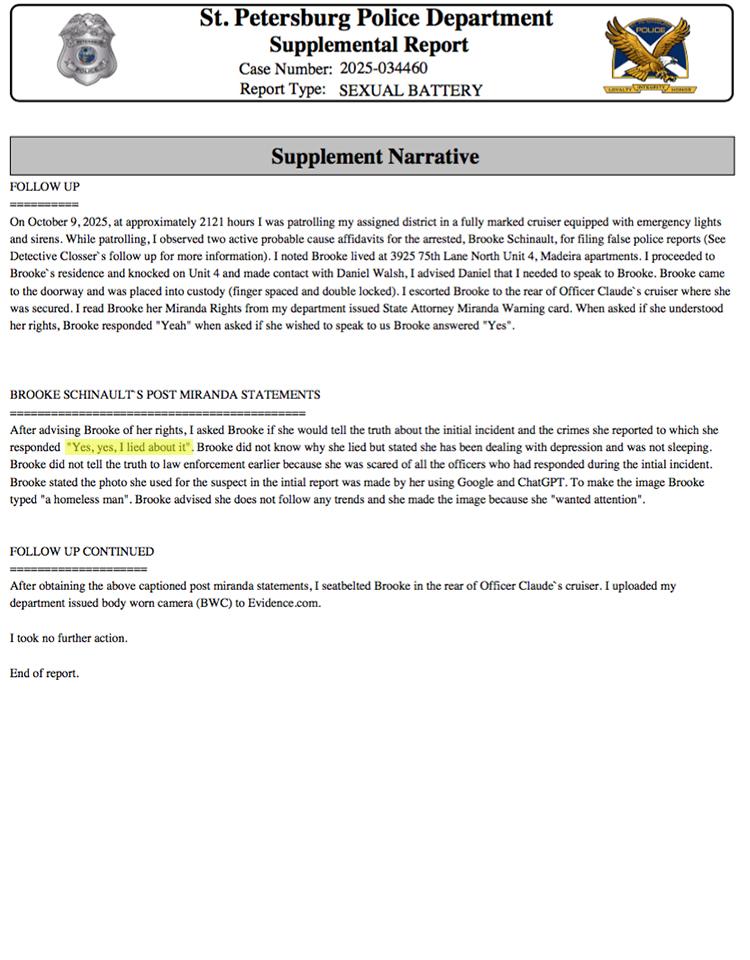
The fabricated-evidence matters share a structure. Material appears to show a real person saying or doing something, it is offered as a record of that event, and its only support is its resemblance to the person. In Mendones v. Cushman & Wakefield, self-represented plaintiffs filed video "testimony" of a witness that the Alameda County Superior Court found was generated. In the Pikesville High School matter in Baltimore County, a recording of a principal's supposed racist remarks circulated for 3 months before police announced it was synthetic. In St. Petersburg, Florida, a complainant gave police a ChatGPT image of an intruder who did not exist.
The enhancement matters are different in kind. In State of Washington v. Puloka, the defense did not invent anything. It took a genuine but blurry bystander video and ran it through commercial AI software to make it clearer. The result looked better, and the prosecution's expert said the added detail was predicted rather than recorded. In the Arizona sentencing of Gabriel Horcasitas, a victim's family openly presented a generated likeness of him reading a statement they had written.
The deepfake defense runs in the opposite direction. In Huang v. Tesla, Tesla declined to admit recordings of Elon Musk's public statements, noting that he is often the subject of deepfakes. In Burnley v. Valentin, a pro se party said a recorded phone call was an AI clone of his voice. Neither side in either case produced evidence that the recordings had been altered.
The conversation-record matters involve a different kind of evidence. Nothing in them was fabricated. In United States v. Heppner, a securities-fraud defendant used Claude on his own to analyze his exposure and outline a defense, then shared the results with his lawyers. The FBI seized 31 of those documents, and Judge Jed S. Rakoff of the Southern District of New York ruled that they were protected by neither attorney-client privilege nor the work product doctrine.
Matters in this topic
18 matters, most recent first within each group. 16 were checked against the primary document, and the others rest on reporting and say so.
Deepfakes offered as evidence
- Adams v. Anderson (Kentucky Court of Appeals)Primary document readIn a divorce case, a mother testified about a child's urgent-care visit and offered a photo of a prescription bottle that the father said was altered or AI-generated. She admitted lying, pleaded guilty to criminal contempt and served 45 days; the Kentucky Court of Appeals affirmed in an unpublished opinion.
- Florida v. Schinault (ChatGPT image false report)Primary document readA St. Petersburg, Florida woman gave police a ChatGPT-generated image of a man she said broke in and assaulted her. A detective recognized it from a viral trend; she pleaded no contest to misdemeanor false reporting and received probation and a fine.
- Mendones v. Cushman & WakefieldPrimary document readSelf-represented plaintiffs in a California housing case filed video "testimony" and altered images in opposing summary judgment. The Alameda County Superior Court found 2 videos were AI-generated and dismissed the case with prejudice.
- Maryland v. Darien (Pikesville High deepfake audio)Reported; document not locatedA recording presented as a Baltimore County principal's racist remarks spread in 2024. Police and forensic analysts found it was AI-generated; the school's former athletic director entered an Alford plea and was sentenced to 4 months in jail.
AI-enhanced media
- State of Washington v. PulokaReported; document not locatedThe defense in a Washington triple-homicide case offered a bystander video enhanced with Topaz Labs AI software. After a Frye hearing the King County Superior Court excluded the enhanced version, and the case was tried on the original footage.
The deepfake defense
- Burnley v. ValentinPrimary document readA pro se litigant accused of breaching a settlement said a recorded phone call was an AI clone of his voice. After a hearing, a federal magistrate judge in Virginia found the recording authentic and enforced the settlement.
- State v. Amyda (deepfake claim without evidence)Primary document readA defendant argued that a video of the charged abuse may have been a deepfake created with generative AI. The Iowa Court of Appeals affirmed its admission, and on October 9, 2026 the Iowa Supreme Court affirmed as well, finding no identifiable circumstances suggesting a deepfake.
- Huang v. TeslaPrimary document readIn a 2023 Autopilot wrongful-death case, Tesla declined to admit recordings of Elon Musk's public statements, noting he is often the subject of deepfakes. The Santa Clara County court ordered a limited 3-hour deposition of Mr. Musk.
Authentication and admissibility
- Matter of M.S. (M.H.)Primary document readA New York family court relied on 3 videos recovered from a hacker's computer to find child abuse. In February 2026 the Court of Appeals, 4-3, held the videos were not properly authenticated and dismissed the petitions, citing the rise of deepfakes.
AI conversations as evidence
- TRAX International Corp. v. United StatesPrimary document readIn a bid protest, the Court of Federal Claims ordered AI-generated proposal evaluations made by an Army analyst with the FAST TRACK tool added to the administrative record, then upheld the contract award. In a separate order it directed government counsel to show cause why they should not be sanctioned for misrepresenting who had seen those evaluations.
- Fry v. Fry (Claude upload and sealing)Primary document readA self-represented petitioner disclosed uploading redacted filings to non-enterprise Claude. The court granted sealing only in part, reasoning the material had already gone to a private company, and had earlier required a prompt-and-input certification.
- Shealy v. Seaside InvestmentsPrimary document readA party forwarded loan documents to his partner, who put them through ChatGPT and returned a drafted response. The court ordered the redacted material produced, holding it was not work product because no attorney directed it.
- Assini v. Hayward (subpoena to OpenAI quashed)Primary document readPlaintiffs subpoenaed OpenAI for a pro se defendant's account records, including prompts, outputs and uploads. The court quashed the subpoena, holding the contents resemble work product, and expressly declined to follow United States v. Heppner.
- Tate Group Automotive v. Legacy Automotive CapitalPrimary document readA non-lawyer party representative's ChatGPT conversations were withheld as work product. After in camera review the court sustained the protection, disagreed with United States v. Heppner, and ordered the party to identify every discovery material it had shared with ChatGPT.
- Tym v. Cerno (AI work product)Primary document readA magistrate judge granted a motion to compel amended discovery responses while sustaining a work product objection over the plaintiff's generative AI interactions and requiring a privilege log.
- Morgan v. V2X (AI work product)Primary document readA self-represented plaintiff's use of an AI system was held to fall within work product protection, but he was ordered to name the platform and the protective order was amended to bar confidential material from systems that train on inputs.
- United States v. HeppnerPrimary document readA criminal defendant used Claude, on his own initiative, to analyze his legal exposure and outline defense strategy, and later shared the results with his lawyers. The FBI seized the documents. The court ruled they were not protected by attorney-client privilege or the work product doctrine.
- Warner v. Gilbarco (ChatGPT work product)Primary document readDefendants sought documents about a self-represented plaintiff's use of ChatGPT and argued the use waived work product. The court denied the request, finding the information neither discoverable nor relevant.
Comparison, metadata and custody in the trial courts
The responses recorded here are concrete. The Alameda County court compared the disputed videos with an authenticated video of the same witness, read the file metadata, and dismissed the case with prejudice after considering and rejecting lesser sanctions. The King County court held a Frye hearing, chose forensic video analysts as the relevant scientific community, and excluded the enhanced clip while leaving the original in evidence. The Santa Clara County court ordered Mr. Musk to sit for a 3-hour deposition limited to whether he made the statements. The federal magistrate judge in Virginia held an evidentiary hearing, heard the recording, took sworn declarations on how it was made and preserved, and found it authentic.
The New York Court of Appeals, in Matter of M.S. (M.H.), reversed findings of child abuse that rested on 3 videos recovered from a hacker's computer. The 4-judge majority said the prevalence of deepfakes made it harder to authenticate a video only by matching details to a real location. The 3 dissenting judges said the decision set too high a bar. The matter did not involve a finding that any video was fake. It turned on who could speak to how the videos were made.
In the criminal matters, the outcomes came through ordinary charges. Dazhon Darien entered an Alford plea to disturbing school operations and received 4 months in jail. Brooke Schinault pleaded no contest to false reporting. Maryland prosecutors told reporters they had asked the legislature to amend the state's identity theft law. Rule changes aimed at machine-generated evidence are under consideration in several jurisdictions, including a proposed federal rule. Those proposals are covered elsewhere in this record.
Authentication methods that predate generative AI
Across these matters, the questions were resolved by methods that predate generative AI: chain of custody, comparison with known exemplars, metadata review, file history on the source device, and testimony from people with knowledge. In none of the entries recorded here did a court rest its decision on the output of an AI detection tool. That is consistent with the Standard's governing test, under which a competent examiner working only from the primary sources, without an AI system, should be able to reproduce the result.
Several clauses of the Standard apply directly. Independent authority means a recording does not vouch for itself. Its provenance has to be confirmed from something outside the file. Checkability before adoption means that enhanced or reconstructed media is usable only where the added content can be traced and tested, which was the problem in Puloka. Reproducible analysis means the examiner's steps should be a procedure another analyst can rerun, not a series of adjustments in an editing program. Contemporaneous record means those steps are logged as they are taken, so the examiner can later show what was done to the file and in what order. Disclosure applies where generated media is shown openly, as it was in Arizona, so the court knows who authored it.
For experts retained to challenge evidence, the deepfake-defense matters carry a parallel lesson. An allegation that a recording is synthetic is a factual claim. Where it was supported by nothing but the general possibility, the courts in Huang and Burnley did not treat it as a reason to set the evidence aside.
Gaps in a small, trial-level record
The record is small, and much of it comes from trial courts. Several of the orders are unpublished, and in some matters only news accounts were available. The Puloka order has not been located in a public source, and the criminal matters in Maryland and Florida are documented through reporting rather than court files. Where that is so, the entry says so.
The record does not show how often fabricated evidence goes undetected, how often a deepfake claim succeeds, or how family courts handle these issues in proceedings closed to the public. A 2019 English custody case in which a parent was reported to have submitted doctored audio is known mainly through the account of the other parent's lawyer. Reports that January 6 defendants suggested video of them could be fabricated have not been matched here to specific rulings. Neither is recorded as an entry.
Four questions for the next deepfake report
When a new matter is reported, 4 questions sort it quickly. First, what exactly was said to be synthetic or altered, and by whom: a party, an expert, the court, or the police. Second, was the claim tested, and by what method, whether comparison, metadata, device examination, testimony or a detection tool. Third, what did the tribunal actually do, such as exclude, admit, sanction, dismiss or refer. Fourth, is there a primary document, or only a news story or a lawyer's account.
Headlines in this area often describe a court as ruling on AI when the court ruled on authentication, relevance or sanctions under existing rules. The entries in this section state what was offered and what the tribunal did, so that a reader can compare a new report with the ones recorded here.
Guides that draw on this topic
Questions that cut across the record, answered from the matters collected here and in the other topics.
- Deepfake Claims About Evidence: How Tribunals Have Ruled: 9 of the matters it discusses are in this topic.
- Discovery of AI Prompts and Chat Logs: What the Record Shows: 9 of the matters it discusses are in this topic.
Primary documents behind this topic
The orders, opinions and published texts that entries in this topic were checked against. Read them before relying on any summary, including the ones here.
- TRAX International Corp. v. United States
Opinion and Order, TRAX International Corp. v. United States, No. 26-796 (Fed. Cl. filed under seal Sept. 3, 2026; reissued Sept. 22, 2026), ECF No. 76 - Fry v. Fry (Claude upload and sealing)
Memorandum and Order on Motion to Seal, Fry v. Fry, No. 26-cv-3469-KSM (E.D. Pa. Aug. 27, 2026) - Shealy v. Seaside Investments
Memorandum and Order on Motion to Compel, Shealy v. Seaside Investments, LLC, No. 2684CV00799-BLS2 (Mass. Super. June 2026) - Assini v. Hayward (subpoena to OpenAI quashed)
Decision and Order, Assini v. Hayward, No. 607683/2024, 2026 N.Y. Slip Op. 26086 (Sup. Ct., Nassau Cnty. June 4, 2026) - Tate Group Automotive v. Legacy Automotive Capital
Minute entry, Tate Group Auto., LLC v. Legacy Auto. Capital, LLC, No. 25-BC11B-0020 (Tex. Bus. Ct., 11th Div. June 3, 2026) (expressly non-final) - Adams v. Anderson (Kentucky Court of Appeals)
Opinion, Adams v. Anderson, No. 2025-CA-1309-MR (Ky. Ct. App. May 29, 2026) (not to be published) - Tym v. Cerno (AI work product)
Order Granting Motion to Compel, Tym v. Cerno, No. 1:25-cv-00498-JCH-JMR (D.N.M. Apr. 22, 2026) - Morgan v. V2X (AI work product)
Order on Motion to Compel, Morgan v. V2X, Inc., No. 25-cv-01991-SKC-MDB, 2026 U.S. Dist. LEXIS 67939 (D. Colo. Mar. 30, 2026) - Burnley v. Valentin
Memorandum Opinion, Burnley v. Valentin, No. 3:23-cv-00160, ECF No. 195 (E.D. Va. Mar. 18, 2026) - Matter of M.S. (M.H.)
Matter of M.S. (M.H.), 2026 NY Slip Op 00825 (N.Y. Feb. 17, 2026) - United States v. Heppner
Memorandum, United States v. Heppner, No. 1:25-cr-00503-JSR (S.D.N.Y. Feb. 17, 2026), ECF 27 - Warner v. Gilbarco (ChatGPT work product)
Order on Discovery, Warner v. Gilbarco, Inc., No. 2:24-cv-12333, 2026 WL 373043 (E.D. Mich. Feb. 10, 2026) - State v. Amyda (deepfake claim without evidence)
State v. Amyda, No. 24-1563 (Iowa Oct. 9, 2026) (Supreme Court opinion; Court of Appeals opinion of Jan. 28, 2026 also read) - Florida v. Schinault (ChatGPT image false report)
St. Petersburg Police Department supplemental report, Case No. 2025-034460 (plea record not located) - Mendones v. Cushman & Wakefield
Order re Terminating Sanctions, Mendones v. Cushman and Wakefield, Inc., No. 23CV028772 (Cal. Super. Ct. Alameda County, Sept. 9, 2025) - Huang v. Tesla
Tentative Ruling, Sz Huang et al. v. Tesla, Inc., No. 19CV346663 (Cal. Super. Ct. Santa Clara County, Apr. 27, 2023)
Questions about this topic
Have courts excluded evidence because it was AI-enhanced?
Yes, at least one trial court has. In State of Washington v. Puloka in 2024, a King County judge excluded a bystander video enhanced with Topaz Labs AI software after a Frye hearing, and the case was tried on the original footage. The order is unpublished.
What happens when a party files deepfake evidence?
In the matters recorded here, the consequences have been serious. In Mendones v. Cushman & Wakefield, the Alameda County Superior Court dismissed the case with prejudice after finding 2 video exhibits were AI-generated. In the criminal matters, people accused of creating or presenting synthetic material were prosecuted under existing statutes, with outcomes of a plea to disturbing school operations and a plea to false reporting.
Can a party avoid genuine evidence by claiming it might be a deepfake?
Not in the matters recorded here. In Huang v. Tesla the court called that position deeply troubling and ordered a limited deposition of Elon Musk, and in Burnley v. Valentin a federal magistrate judge found a recording authentic after the party offered no evidence it had been cloned. Each court tested the claim with ordinary evidence and did not accept the bare possibility of fabrication.
Do courts rely on AI deepfake detectors to decide authenticity?
None of the decisions recorded here rests on a detection tool. The courts relied on chain of custody, comparison with authenticated recordings, metadata, device file history and witness testimony. Those methods let another examiner check the result, which is the governing test of the Standard.
What should an expert document when examining a disputed recording?
An expert should document the provenance of the file from the source device, every step taken in the analysis, and the basis for any conclusion, logged as the work is done. If any software alters or enhances the material, the expert should record what it did and whether a peer could reproduce it. Enhanced output should not replace the original.
Are conversations with an AI chatbot protected by attorney-client privilege?
In the one ruling recorded here, they were not. In United States v. Heppner in February 2026, Judge Jed S. Rakoff of the Southern District of New York ruled that documents a defendant created with Claude, on his own initiative and later shared with counsel, were not privileged and were not work product. The court pointed to the fact that the system is not a lawyer, to the provider's privacy policy, and to the absence of any direction from counsel.